LINC Motive Drivers and Leadership Development
If you’ve read my earlier blog on McClelland’s theory on motivations and Acquired Human Needs, you’ll probably be wondering how this idea fits into the LINC Personality Profile (LPP). One of the distinguishing elements of the LPP is the integration of this motivation framework into the Big Five personality model along with a competency framework. These three things in combination make the LPP the most interesting and pragmatic tool for developing leaders, in my opinion. But it is the Motive Structure that is the binding glue. The LPP’s Big Five model tells me how I am as a person, from a psychologically valid and reliable point of view. The Competency model tells me what I’m good at, by nature and by effort. But the Motive Structure tells me how I can be motivated to develop and why it might matter to me.
Sidebar: I’m a GenXer
I’m a GenXer, so, early in my career, you could have just told me I had to develop these skills. I’d have put my head down and done it, maybe grudgingly. Subsequent generations, and especially GenZ, are wiser perhaps - they need and deserve a little more in their development. More important for organizations, they also will not accept the “just do it” attitude of some GenX managers. And if you want this talented group to dig in and engage, they need to know why for them. This is exactly what the LPP delivers. I can hear my GenX peeps howling with outrage in the distance. Hey, friends, go read up on the empathy gap. Just because we did doesn’t mean others should. I would have preferred more support and rationale in my early career. My “can do” attitude led to a “can burnout” reality.
Back to Motive Structures.
The LPP Motive Structure aligns with McClelland’s theory, extrapolating nine needs from the three discussed in the previous blog: Influence, Independence, Security, Relationships, Values, Lifestyle, Performance, Growth, Creativity. Here’s mine:
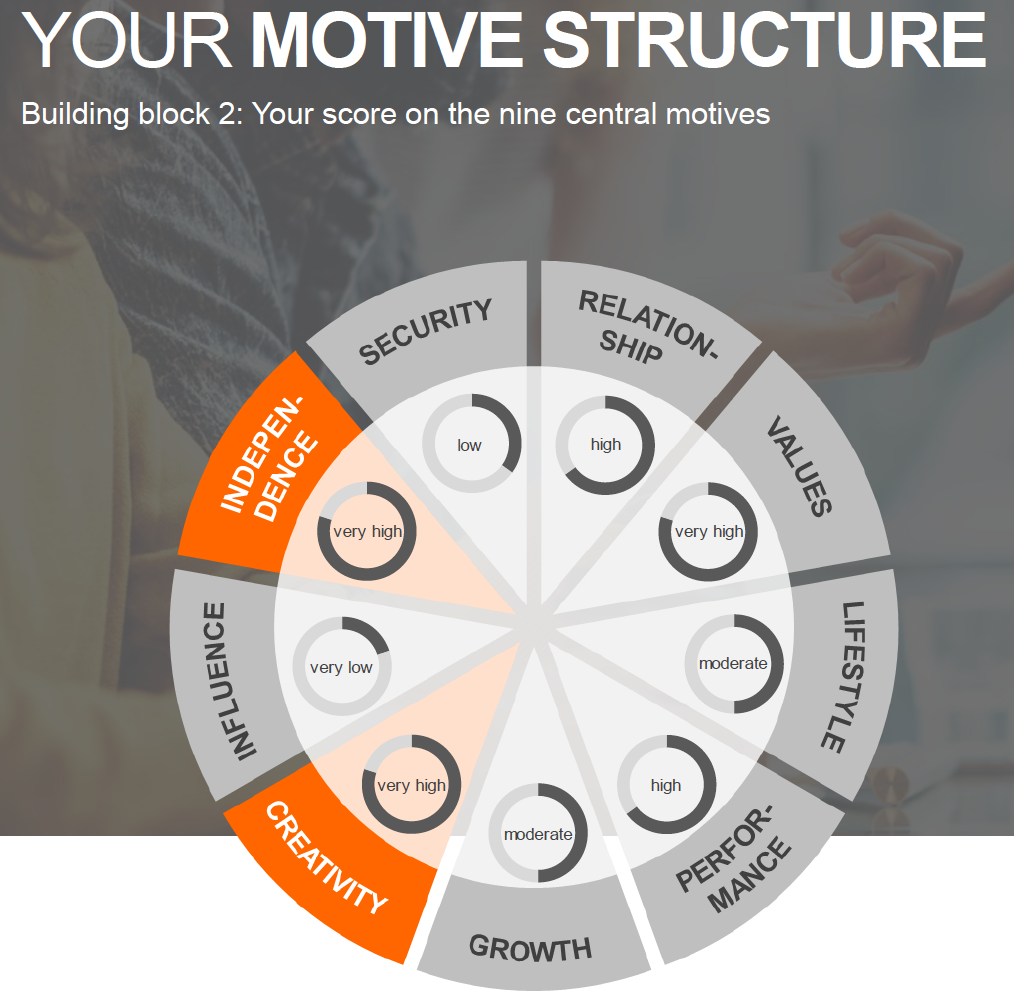
LPP Motive Structure, with dominant motives highlighted
Every person is motivated by all of these nine, but we often have several that are dominant. In McClelland’s view, we have learned these needs and they tend to motivate our decision-making and behaviors more strongly than the other needs. These motivators help us (and our teams) understand how to move us or why we move ourselves. Here’s a rather dry but useful video on why businesses outperform when they pay attention to this!
Working with Peter
My two dominant motivators are Creativity and Independence, followed closely by Values. Interestingly but unsurprisingly, this aligns exactly with some of what I’ve learned from other tools I've used with clients. But I never saw how it was part of my motivation framework! If you need to get me moving on something, in other words, you are going to get nowhere by suggesting that I can acquire power and influence or that a new position or skillset will give me security. It’s not that I don’t care about these things (who doesn’t to some degree!?). It’s just that these motives are very unlikely to shift me into new behaviors or mindsets. But, suggest that I can approach this development with autonomy or that this position give me more agency over my days - suggest that I can apply creative problem solving or will be required to come up with innovative solutions to problems…
Hold my beer.
Please note that the job or development task may not change. What is changing is how you are directing my attention and my motivation to accomplish what is needed.
Who cares?
Anyone whose job it is to run L&D programming, to develop leaders, or to manage reports cares IMMENSELY about motivating their people to learn, grow, or perform. The Motive Structure in the LPP gives us a roadmap to building a motivation model that is fit for purpose, that honors the individual, and that gets results. Have you been wondering why setting those new KPIs isn’t changing performance? Or have you been wondering why giving more autonomy isn’t helping your people get the work done? It may be that you’re giving them what YOU need for motivation, not what THEY need. Aren’t you curious how you show up to work? Send me an email - let’s find out what makes you tick! You cannot lead others consistently and effectively until you know what motivates you and what motivates them.
Check back soon for how the LPP can be used to address what other systems judge as “derailers” from a holistic and developmental point of view.
